 EN
 IT Italiano
 ES Español
 FR Français
 DE Deutsch
Description
Tutorial: How to Use LT6005IGNPBF
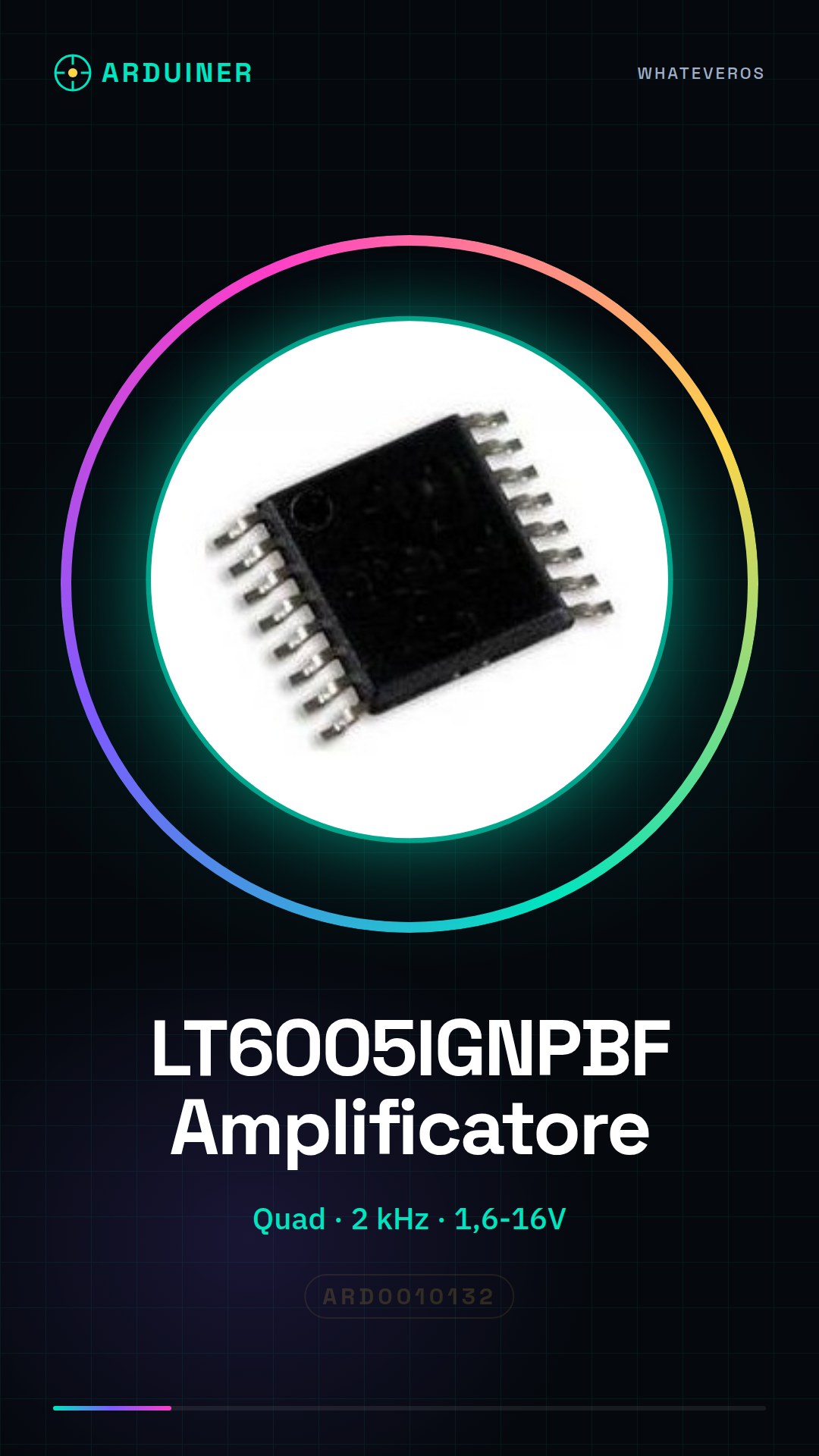
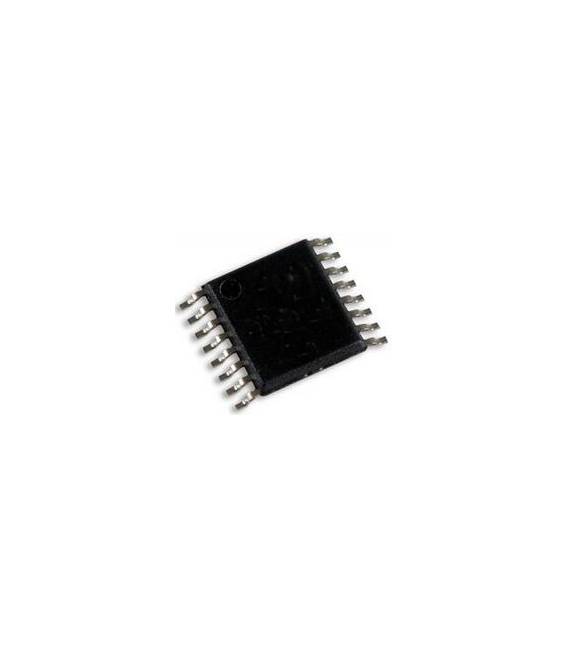
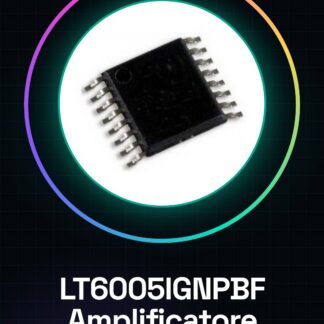
The LT6005IGNPBF operational amplifier is ideal for electronic projects requiring low distortion and good signal-to-noise ratio. This component is particularly useful for beginner and intermediate makers developing measurement or filtering circuits.
What you need
- Arduino Uno
- Breadboard
- Jumper wires
- Resistor
- Capacitor
Steps
- Step 1: Identify the pins of the LT6005IGNPBF operational amplifier and read the datasheet to understand their function.
- Step 2: Connect the circuit power supply (from 1.6V to 16V) to the amplifier’s power pins V+ and V-.
- Step 3: Place a capacitor between the power pins to filter out any noise.
- Step 4: Connect the signal to be amplified to the input signal pin (IN+ and IN-).
- Step 5: Configure the output of the operational amplifier by connecting a resistor between the output (OUT) and one of the power supply pins.
- Step 6: Connect the breadboard to the Arduino Uno to send the amplified signals to the microcontroller.
- Step 7: Check for connection errors using a multimeter.
- Step 8: Test the operational amplifier with a known signal source.
Mini project
Create a noise sensor that amplifies acoustic sounds and sends them to the Arduino to display the noise level.
Common mistakes
- Incorrect connection of power supply pins
- Unwanted noise due to lack of filtering capacitors
- Incorrect impedance between the output and power supply pins
Recommended accessories
- Arduino Uno
- Breadboard
- Decoupling capacitor
- Variable resistors
Frequently asked questions
What is the maximum frequency I can amplify with this operational amplifier?
Check the datasheet for the exact value, but it is generally around 2 kHz.
Can I use the operational amplifier LT6005IGNPBF as a buffer?
Yes, it can be used as a buffer if properly configured with feedback resistors.
How can I reduce unwanted noise in the amplified signal?
Add decoupling capacitors between the power pins and ground.
Reviews
There are no reviews yet.