 EN
 IT Italiano
 ES Español
 FR Français
 DE Deutsch
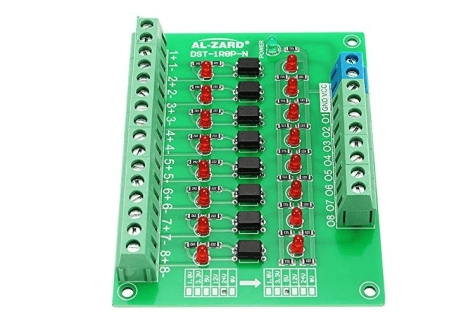
Description
What it is
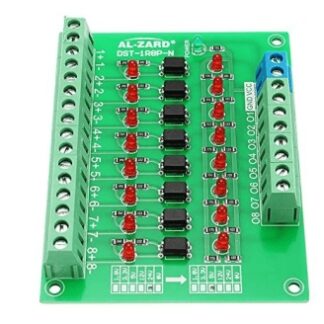
The DST-1R8P-N module is an 8-channel optical coupler that converts voltage from 24V to 5V. This type of module allows for isolating electronic circuits at different voltages, protecting them from interference and current spikes.
Features
- 8-channel optical isolation
- 24V to 5V voltage conversion
- NPN output
What it is for
This module is ideal for industrial applications that require isolation and safety, such as PLC systems. It can also be used in industrial automation projects and Arduino prototypes to isolate sensitive circuits from current spikes.
Tutorial: How to use 8-channel optical coupler isolation module DST-1R8P-N
The DST-1R8P-N optical isolator module is useful for protecting sensitive circuits from current spikes and for isolating signals between circuits of different voltages. It is ideal for industrial automation projects and Arduino prototypes that require electronic isolation.
What you need
- Arduino Uno
- Connection cable
- Multimeter
- NPN sensors
Steps
- Connect the Arduino to the isolation board
- Check the module’s supply voltage (check the datasheet)
- Connect the NPN sensors to the input channels
- Check the operation of the output channels
- Configure the Arduino sketch to read the signals
- Test the communication between input and output
- Verify the isolation between circuits
- Detect any malfunctioning errors
Example code
void setup() {
  Serial.begin(9600);
}

void loop() {
  int val = digitalRead(2); // Legge il segnale dal canale di ingresso
  Serial.println(val);
}
Mini project
Create a home alarm system with motion sensors connected to the isolation module and an LCD display to show the status of the sensors
Common mistakes
- Incorrect power supply voltage
- Incorrect NPN sensor connection
- Arduino sketch configuration error
- Insulation problems
Recommended accessories
- Arduino Uno
- LCD Display
- PIR Motion Sensors
- Connection Cables
Frequently asked questions
Why is insulation important?
Insulation protects sensitive circuits from current spikes and electronic interference.
What are the advantages of using NPN sensors?
NPN sensors are more cost-effective and consume less energy compared to PNP sensors.
Reviews
There are no reviews yet.