 EN
 IT Italiano
 ES Español
 FR Français
 DE Deutsch


Description
What it is
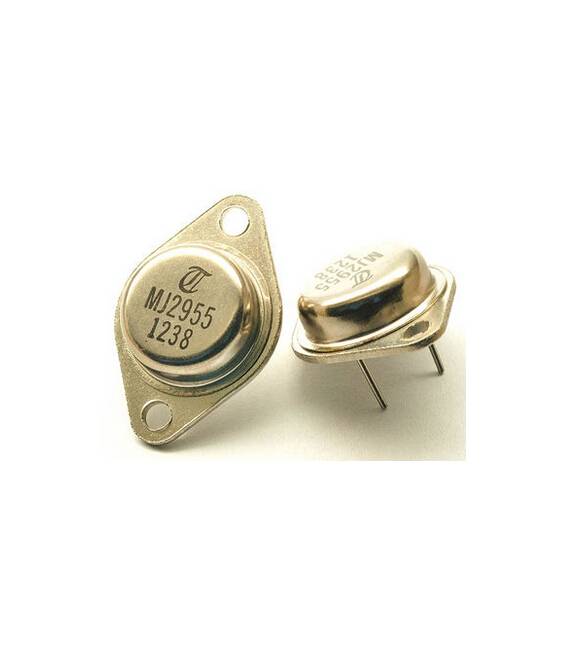
The MJ2955 TO-3 is a general-purpose (GP) PNP bipolar transistor (BJT) with a maximum blocking voltage of 60V and a maximum collector current of 15A. This component is designed for advanced applications requiring high power.
Features
- Maximum blocking voltage: 60V
- Maximum collector current: 15A
- TO-3 package with 3 pins (2 + Tab)
What it is for
The MJ2955 transistors are useful for amplifying electrical signals in power amplification circuits. They are suitable for projects requiring precise current control, such as audio amplification or controlling high-power devices.
Tutorial: How to use MJ2955 Trans GP BJT PNP
The MJ2955 is a PNP transistor used to amplify electrical signals. Ideal for projects requiring current amplification or device control.
What you need
- MJ2955 Trans GP BJT PNP
- Resistor
- Power supply
- Test circuit
Steps
- 1. Install the MJ2955 on a small circuit or a protoboard.
- 2. Connect pin 1 (emitter) to a resistor.
- 3. Connect the other end of the resistor to ground.
- 4. Connect pin 2 (base) to the control signal.
- 5. Connect pin 3 (collector) to the power supply.
- 6. Check the datasheet for power specifications.
- 7. Test the circuit with a test signal.
- 8. Adjust the base signal to control the device.
Mini project
Create a simple amplification circuit for an LED. Connect the output of the MJ2955 to the LED and control the intensity with a variator.
Common mistakes
- Do not check the specifications on the datasheet.
- Connect the base to the collector.
- Ignore the protection resistor.
- Power the transistor with voltages above 60V.
Recommended accessories
- LED
- Variator
- 10kΩ resistor
- Protoboard circuit
Frequently asked questions
How can I verify the proper functioning of the MJ2955?
Measure the voltage between the base and the emitter. If there is a control signal, you should see a variation.
What are the risks of incorrect usage?
Incorrect power supply, exceeding the maximum current, permanent damage to the transistor.
Can I use this transistor with an Arduino?
Yes, but make sure to properly regulate the base signal.
Which resistor should I use to protect the transistor?
Use a 10kΩ resistor between the base and the control signal.




Reviews
There are no reviews yet.