 EN
 IT Italiano
 ES Español
 FR Français
 DE Deutsch
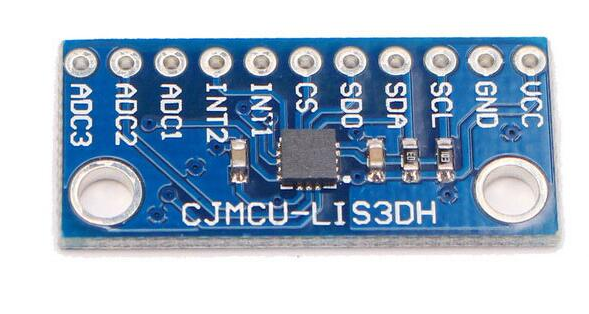
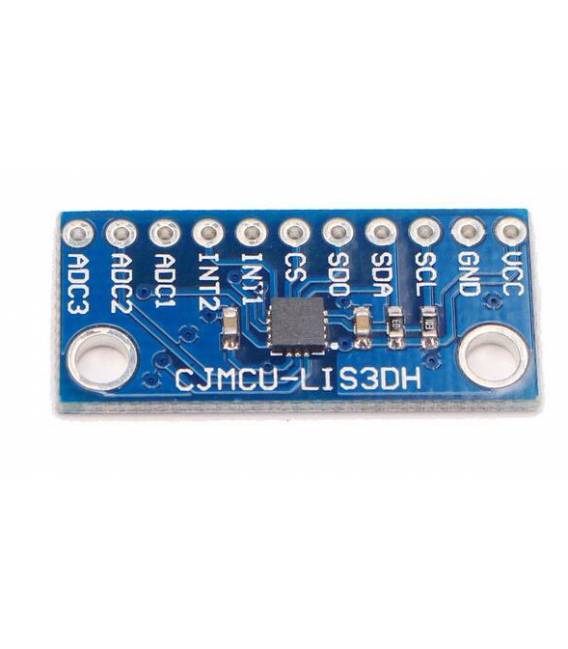
Description
What it is
The CJMCU LIS3DH is a 3-axis accelerometer module compatible with Arduino. It allows measuring acceleration along three directions (X, Y, and Z axes) and can be used in a variety of applications that require movement measurement.
Features
- 3-axis Accelerometer
- Compatible with Arduino
- SKU: ARD009436
- Price: 11.29 €
What it is for
The CJMCU LIS3DH accelerometer is ideal for movement and vibration projects. It can be used, for example, to create a keyboard-controlled drone cart, to monitor machine vibrations, or to build a motion sensor.
Tutorial: How to use CJMCU LIS3DH
The CJMCU LIS3DH accelerometer is ideal for measuring acceleration in 3 axes. Useful for movement and vibration projects.
What you need
- Arduino UNO or compatible
- FTDI cable or USB port
- Multimeter
- Check the datasheet
Steps
- 1. Installation: Download the I2C driver for Arduino.
- 2. Connection: Connect VCC to 3.3V, GND to GND, SDA to A4, SCL to A5.
- 3. Code: Upload the ‘LIS3DH’ sketch to your Arduino.
- 4. Test: Use Serial Monitor to display readings.
- 5. Configuration: Replace the sensitivity parameters in the code.
- 6. Calibration: Check accuracy with a multimeter.
- 7. Test: Attach to the main project.
- 8. Debug: Check connectors and power supplies.
Example code
```void setup() { Wire.begin(); LIS3DH.begin(); } void loop() { int16_t x, y, z; LIS3DH.getAcceleration(&x, &y, &z); Serial.print("x:"); Serial.print(x); Serial.print(" y:"); Serial.print(y); Serial.print(" z:"); Serial.println(z); } ```Mini project
Create a project below: a drone cart that moves with the A, S, D, F keys.
Common mistakes
- Forgot to calibrate the accelerometer.
- Incorrect power supply (5V instead of 3.3V).
- Incorrect I2C connections.
- Sensitivity not configured correctly.
Recommended accessories
- I2C cable
- 10kΩ resistor
- ESD protection
- Arduino support
Frequently asked questions
How to configure sensitivity?
Check the datasheet for the ‘setFullScale’ function in the code.
Why are the readings incorrect?
Check the connectors and power supply. Use a multimeter to verify.
What are the differences with the ADXL345?
LIS3DH offers a wider range and improved sensitivity.
Can I use this module with other microcontrollers?
Yes, the module supports I2C and is compatible with many microcontrollers.
Reviews
There are no reviews yet.