 EN
 IT Italiano
 ES Español
 FR Français
 DE Deutsch
Description
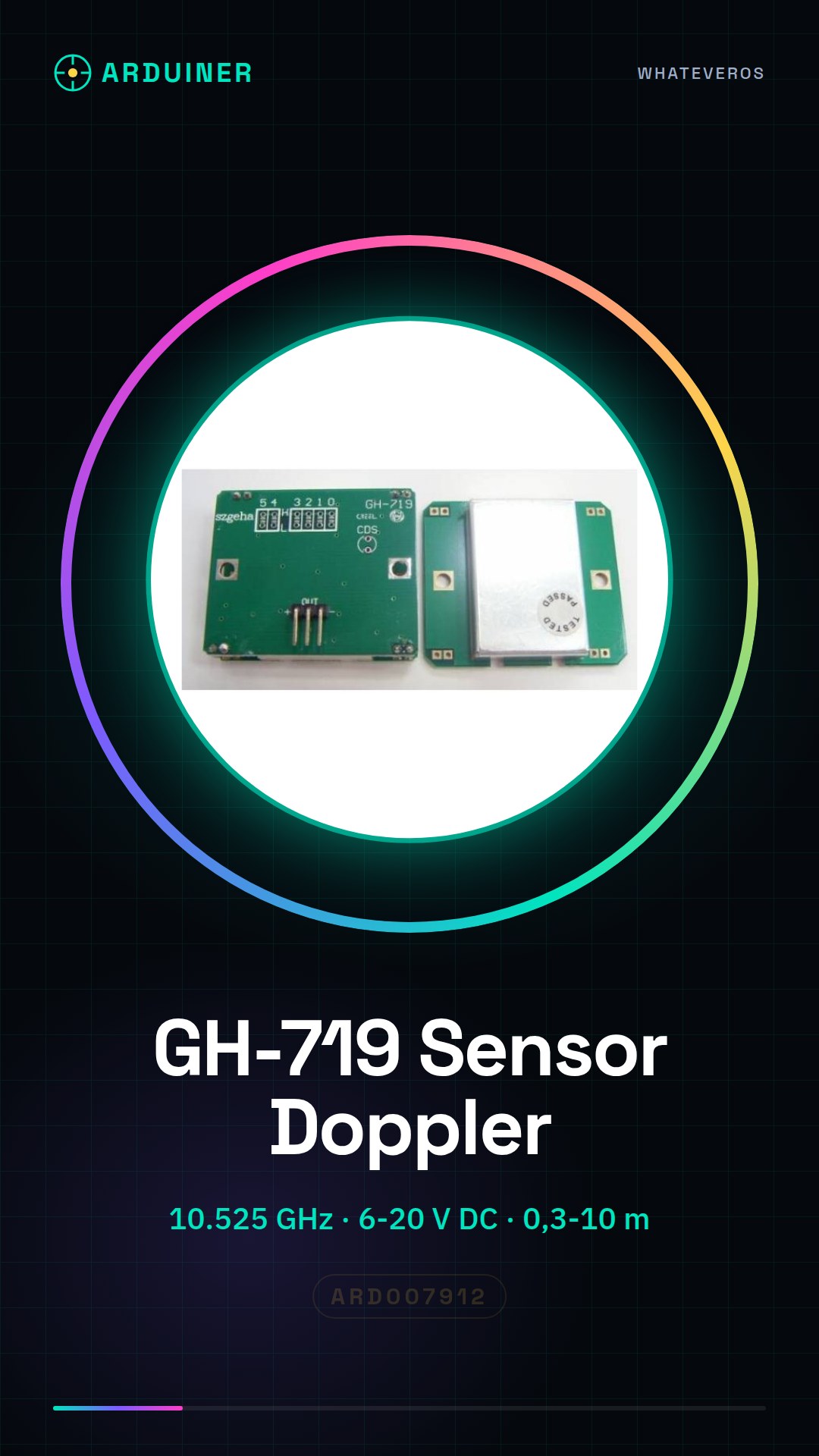
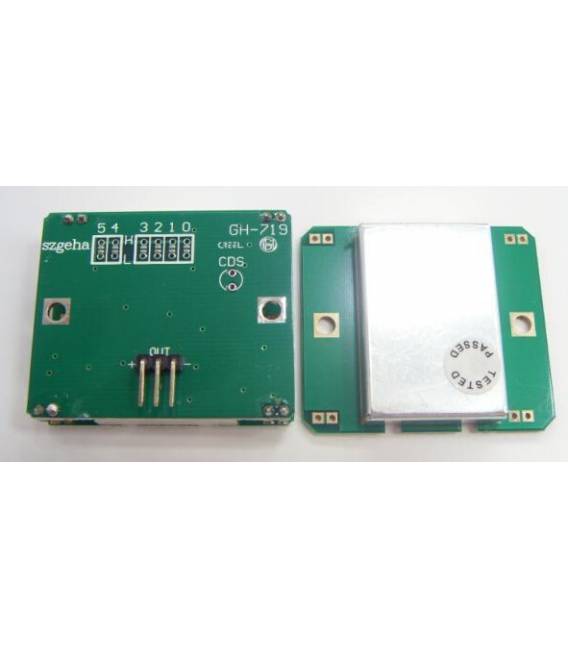
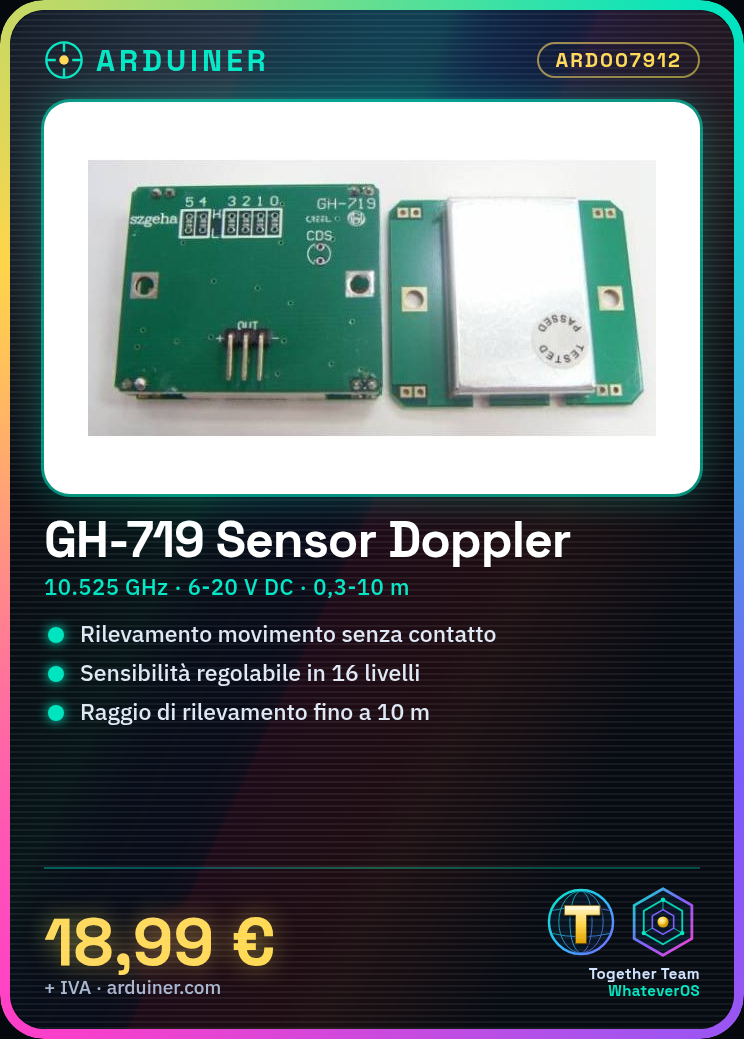
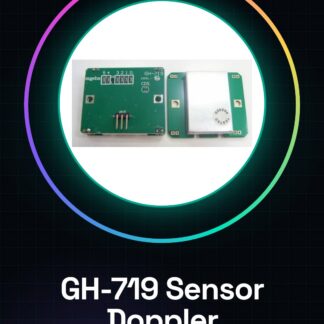
Microwave Doppler Motion Detection Sensor Module GH-719 GH719
Microwave GH-719 Movement Module for use:
The microwave movement sensor module GH-719 uses the design principles of the Doppler (Radar Doppler) to detect moving objects, with a microwave frequency of 10.525GHz, and operates directly with a DC power supply of 6-20V.
GH-719 Microwave Sensor the signal processing module utilizes SCM process analysis and high reliability. The printed circuit board has 16 sensitivity adjustments, adjustable detection range from 0.3 to 10 meters. 4 types of signal output delay time mode selection: 2 seconds, 3 seconds, 10 seconds, 20 seconds, in addition to the photoresistor trigger inhibits during the day, mainly used in automatic door control switches, industrial automation and control, indoor and outdoor security systems, automatic ATM control systems, ATM video surveillance systems, field security warnings, and other places.
The GH-719 microwave sensor module is a non-contact motion detection module with RFI capacity, temperature and humidity independent, light, air, dust impact independent, can be installed in a certain thickness of plastic, glass, wood and other non-metallic shells inside, convenient for controlling a variety of products or equipment above.
Second sensitivity adjustment circuit board Description:
A sensitivity adjustment to 16 levels: the board has four connection points marked 0123.
1: short circuit the following four connection points, the sensitivity can be adjusted to 16 levels, the detection range cap is adjustable within 0.3-10 meters.
2: 4 connection points disconnected, detection range recent, within 0.5 meters.
3: 1 connection point for short circuit, not short circuit on 0, all short circuits, maximum sensitivity, regulated as follows:
1: 0000.2: 0001.3: 0010.4: 0011.5: 0100.6: 0101.7: 0110.8 : 0111.
8: 1000.9: 1001. a: 1010. b: 1011. c: 1100. d: 1101. e: 1110. f: 1111.
B 4 trigger modes Regulation: the printed circuit board has two connection points labeled 45 inches.
1:00 non-repeatable trigger type:
Detects moving objects, output signal high for 3 seconds after stop, 2 seconds delay before test, to detect moving objects and output for 2 seconds, followed by cycle. Not detectable until the moving objects, the output signal high stops.
2:01 repeatable trigger type, 2 second delay:
Detect moving objects, high signal output for 2 seconds, 2 seconds in time, the module at a frequency of 30 times per second, unable to detect if a moving object is detected again, 2-second delay to continue, not detectable until a moving object is present again,
High signal delay 2 seconds after stop.
3:10 trigger type repeatable touch, 10-second delay time:
Detect moving objects, high-level signal output for 10 seconds, within 10 seconds, the module frequency 30 times per second
Unable to detect if a moving object is detected again, 10-second delay to continue until detecting moving objects,
High signal delay 10 seconds after stop.
4:10 repeatable trigger type – touch, 20-second delay time:
Motion object detected, emits 20 seconds of high-level signal within 20 seconds, module 30 times per second frequency
It is not possible to detect if an object is being moved again, the 20-second delay to continue until it detects moving objects,
20-second high signal delay after stopping.
CDS photosensitive resistance:
1: The photoresistor Connect can be suppressed during the day or activated in a relatively bright environment.
2: Activates a valid:
Therefore, it is possible to activate the photoresistor, at night or in low-light conditions, when an object in motion is detected. Within the selected trigger mode time, even if the light changes from dark to bright, it does not change the trigger state and delay time until the output signal drops; the photoresistor only controls the action.
Precautions:
Selected sensitivity and trigger mode, the controller must perform a new selection function after power restoration.
Three main technical parameters:
Central frequency: 10.525 GHz 2 Operating voltage: DC3.7V – 20V
3 Quiescent current: 2mA 4 Output high/low level: 3.3V / 0V
5 3 dB antenna pattern – azimuth 80 6 3 dB antenna pattern – elevation 40
7 Detection range: 1-12 m 16 Adjustable 8 Trigger: four options
Ambient temperature: -30-70 degrees 10 Form factor: 45 * 37 * 15mm
Tutorial: How to use GH-719
The GH-719 detector is ideal for detecting movements in domestic or industrial environments. Useful for anyone who wants to implement security or control features.
What you need
- GH-719
- Arduino
- 10kΩ resistor
- 5V power cable
- Ground cable
Steps
- 1. Connect the sensor to the Arduino via the VCC and GND pins.
- 2. Connect the 10kΩ resistor between the OUT pin and GND.
- 3. Load the provided Arduino code.
- 4. Power on the Arduino and check the status of the LED.
- 5. Try moving in front of the sensor.
- 6. Check if the LED lights up when someone approaches.
- 7. Adapt the sensor to the usage environment.
- 8. Test the functionality of the sensor.
Example code
```void loop() { if (digitalRead(OUT_PIN) == HIGH) { digitalWrite(LED_PIN, HIGH); } else { digitalWrite(LED_PIN, LOW); } }```Mini project
Build a simple alarm system by connecting the GH-719 sensor to an Arduino and a bell.
Common mistakes
- Do not connect the VCC and GND pins incorrectly.
- Use a resistor other than 10kΩ.
- Do not verify the correct power supply of the sensor.
- Ignore the pin output configuration.
Recommended accessories
- Arduino UNO
- Doorbell
- LED
- 1kΩ Resistor
Frequently asked questions
The sensor does not detect movements?
Check the correct power supply and the pin output configuration. Check the position of the sensor.
Which pins to use?
Connect VCC to 5V, GND to ground, and OUT to the digital pin of the Arduino.
The sensor does not work in a bright environment?
The GH-719 sensor is designed to detect movements regardless of light. Check the position of the sensor.
Reviews
There are no reviews yet.