 EN
 IT Italiano
 ES Español
 FR Français
 DE Deutsch
Description
Technical Description
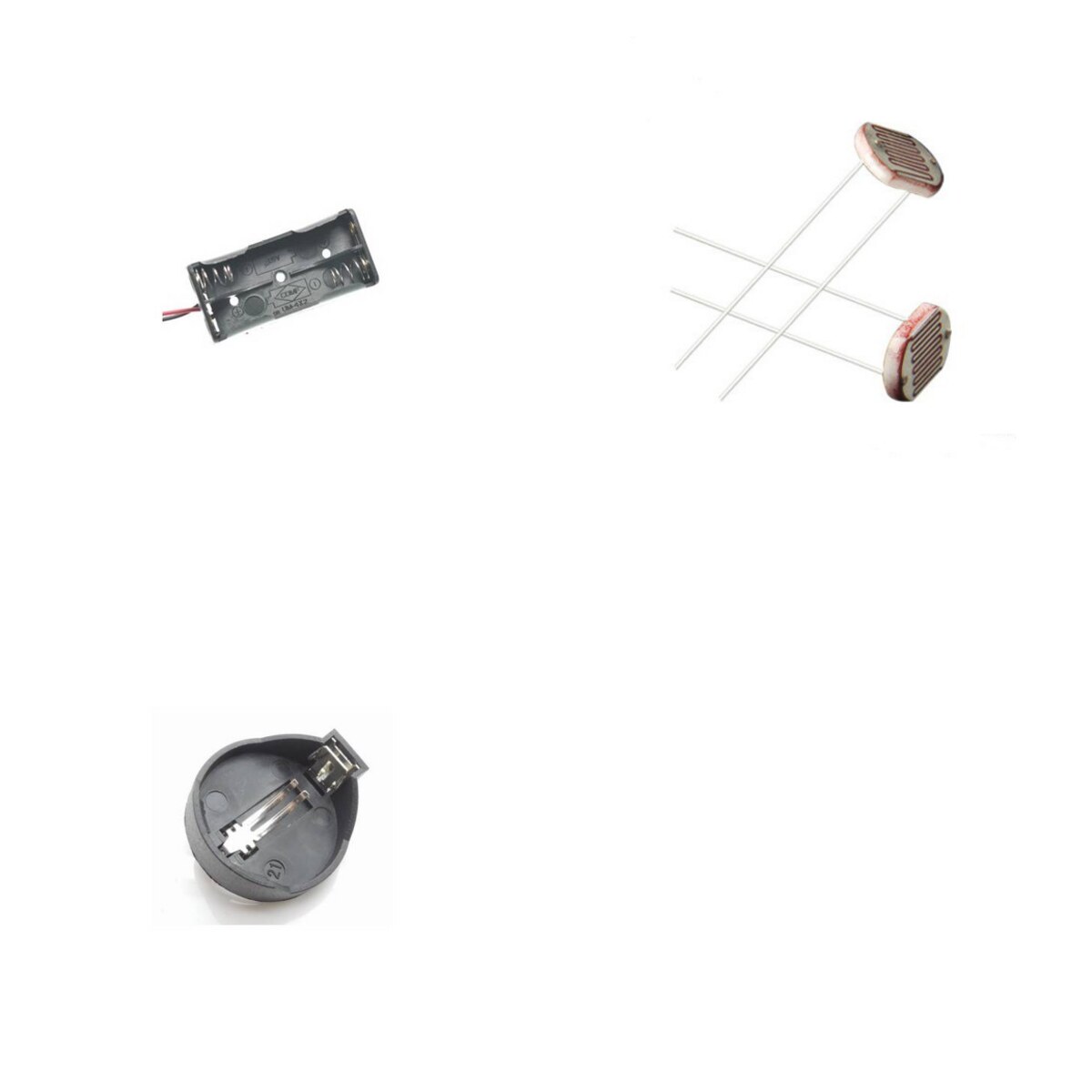
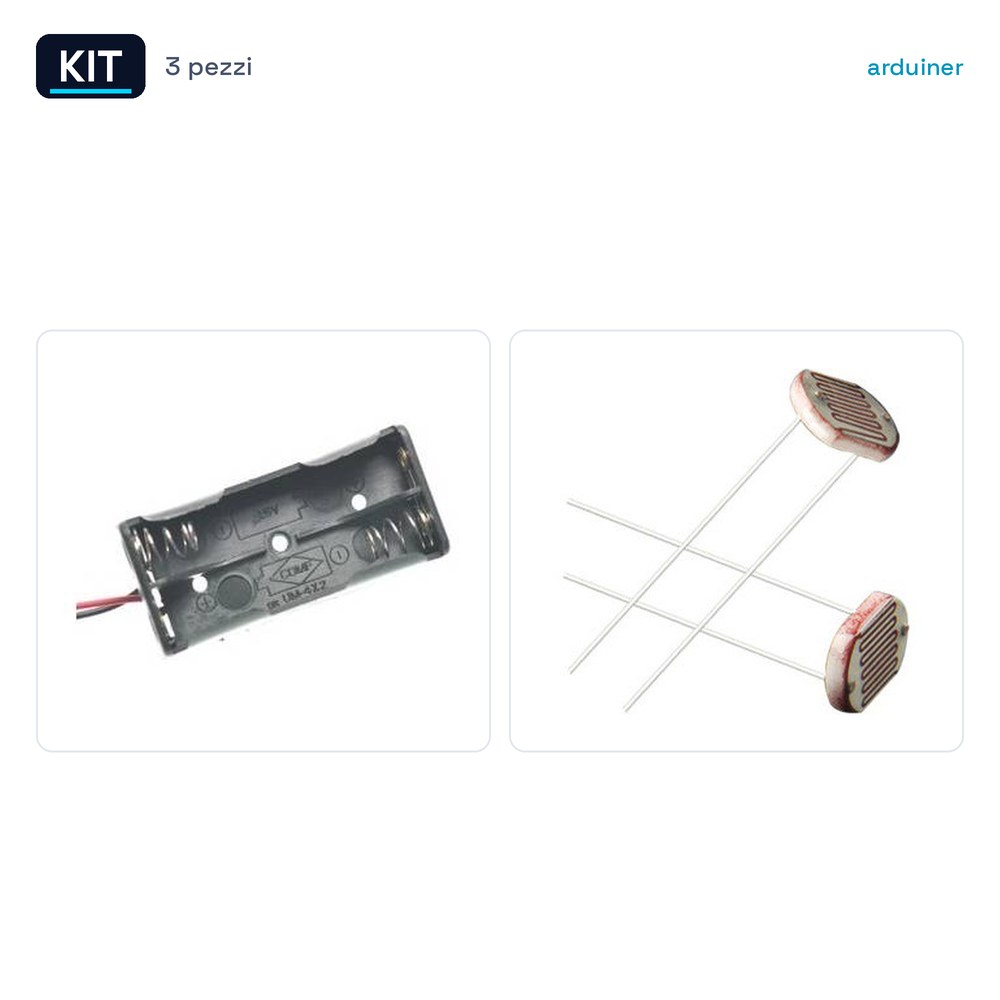
The ARD0014943 kit includes a AA battery holder with 2 slots, 20 LDR photoresistors compatible with Arduino, and 5 CR2032 battery sockets. The AA holder is designed to accommodate standard AA batteries, while the CR2032 sockets are useful for powering small and portable devices. The LDR photoresistors can be used to measure light intensity in various electronic projects.
LDR photoresistors vary their resistance based on incident light, allowing for the measurement of ambient light levels. CR2032 sockets are suitable for powering small integrated circuits or microcontrollers.
This kit is useful for projects that require precise power management and ambient light level measurement.
Key Specifications
| Parameter | Value |
| Model | Kit ARD0014943 |
| AA Battery Holder | 2 slots |
| LDR Photoresistors | 20 pieces |
| CR2032 Sockets | 5 pieces |
| Battery Type AA | N/D (see manufacturer’s technical sheet) |
| Battery Type CR2032 | N/D (see manufacturer’s technical sheet) |
| AA Battery Holder Dimensions | N/D (see manufacturer’s technical sheet) |
| Photoresistor LDR Dimensions | N/D (see manufacturer’s technical sheet) |
| CR2032 Battery Socket Dimensions | N/D (see manufacturer’s technical sheet) |
Installation and Usage
- Install the AA battery holder: open the holder and insert the AA batteries.
- Check the electrical connectivity of the AA battery holder: use a multimeter to check continuity.
- Install the photoresistors LDR: connect the wires to the ends of the photoresistor.
- Check the variable resistance of the photoresistor: expose the photoresistor to different light intensities.
- Install the CR2032 battery sockets: insert the CR2032 batteries into the sockets.
Compatibility and Requirements
- The AA battery holder is compatible with most projects that require AA battery power.
- The LDR photoresistors are compatible with Arduino and other microcontrollers.
- The CR2032 sockets are useful for powering small electronic devices.
Limitations and Important Notes
- The AA battery holder does not include batteries.
- The LDR photoresistors do not include a temperature indication.
- The CR2032 sockets are not designed for larger batteries.
Troubleshooting
The photoresistor does not change resistance.
Probable cause: The photoresistor may be damaged.
Solution: Replace the photoresistor with a new one.
The AA battery holder does not power correctly.
Probable cause: The batteries may be discharged.
Solution: Replace the batteries with new ones.
The CR2032 socket does not power the device.
Probable cause: The battery might be inserted incorrectly.
Solution: Check the correct insertion of the battery.
The photoresistor does not respond to light changes.
Probable cause: The wires might be disconnected.
Solution: Check and reconnect the wires.
Use cases
Garage light sensor
Objective: Measure the light intensity in the garage.
What is needed: Photoresistor LDR.
Steps: 1) Connect the photoresistor to a microcontroller. 2) Program the microcontroller to measure the resistance of the photoresistor. 3) Display the light data on a display.
Expected result: The system correctly measures the light intensity in the garage.
Powering a temperature sensor
Objective: Power a temperature sensor.
What is needed: CR2032 socket.
Steps: 1) Insert CR2032 battery into socket. 2) Connect temperature sensor to socket. 3) Program microcontroller to read sensor data.
Expected result: The temperature sensor works correctly.
Automatic Lighting Project
Objective: Automatically regulate lighting.
What you need: Photoresistor LDR.
Steps: 1) Connect the photoresistor to a control circuit. 2) Program the circuit to adjust lighting based on ambient light.
Expected result: Lighting adjusts automatically based on ambient light.
Powering an OLED display
Objective: Power an OLED display.
What you need: CR2032 battery socket.
Steps: 1) Insert CR2032 battery into socket. 2) Connect the OLED display to the socket. 3) Program the microcontroller to display data.
Expected result: The OLED display works correctly.
Domestic Security System
Objective: Monitor ambient lighting.
What’s needed: Photoresistor LDR.
Steps: 1) Connect the photoresistor to a security system. 2) Program the system to alert in case of light changes.
Expected result: The security system correctly monitors ambient lighting.
Home Automation Project
Objective: Automatically regulate lighting.
What’s needed: Photoresistor LDR.
Steps: 1) Connect the photoresistor to an automation system. 2) Program the system to regulate lighting based on ambient light.
Expected result: Lighting adjusts automatically based on ambient light.
Environmental Monitoring Project
Objective: Measure light intensity.
What’s needed: Photoresistor LDR.
Steps: 1) Connect the photoresistor to a monitoring system. 2) Program the system to record light data.
Expected result: The system correctly records light data.
Energy control project
Objective: Automatically regulate lighting.
What’s needed: Photoresistor LDR.
Steps: 1) Connect the photoresistor to an energy control system. 2) Program the system to adjust lighting based on ambient light.
Expected result: Lighting adjusts automatically based on ambient light.
In the package
- Kit 2 slot AA battery container + 20 pieces LDR photoresistor + 5 pieces CR2032 battery socket
Complete the project
- 1 slot AA battery container: For projects requiring AAA battery power.
Technical FAQs
How to connect the LDR photoresistor?
Connect the photoresistor wires to a microcontroller to measure the variable resistance.
Why doesn’t the CR2032 socket power the device?
Check the correct insertion of the CR2032 battery into the socket.
Which batteries are compatible with the AA container?
Standard AA batteries are compatible with the container.
Which batteries are compatible with the CR2032 sockets?
CR2032 batteries are compatible with the sockets.
Reviews
There are no reviews yet.