 EN
 IT Italiano
 ES Español
 FR Français
 DE Deutsch
Description
Technical Specifications
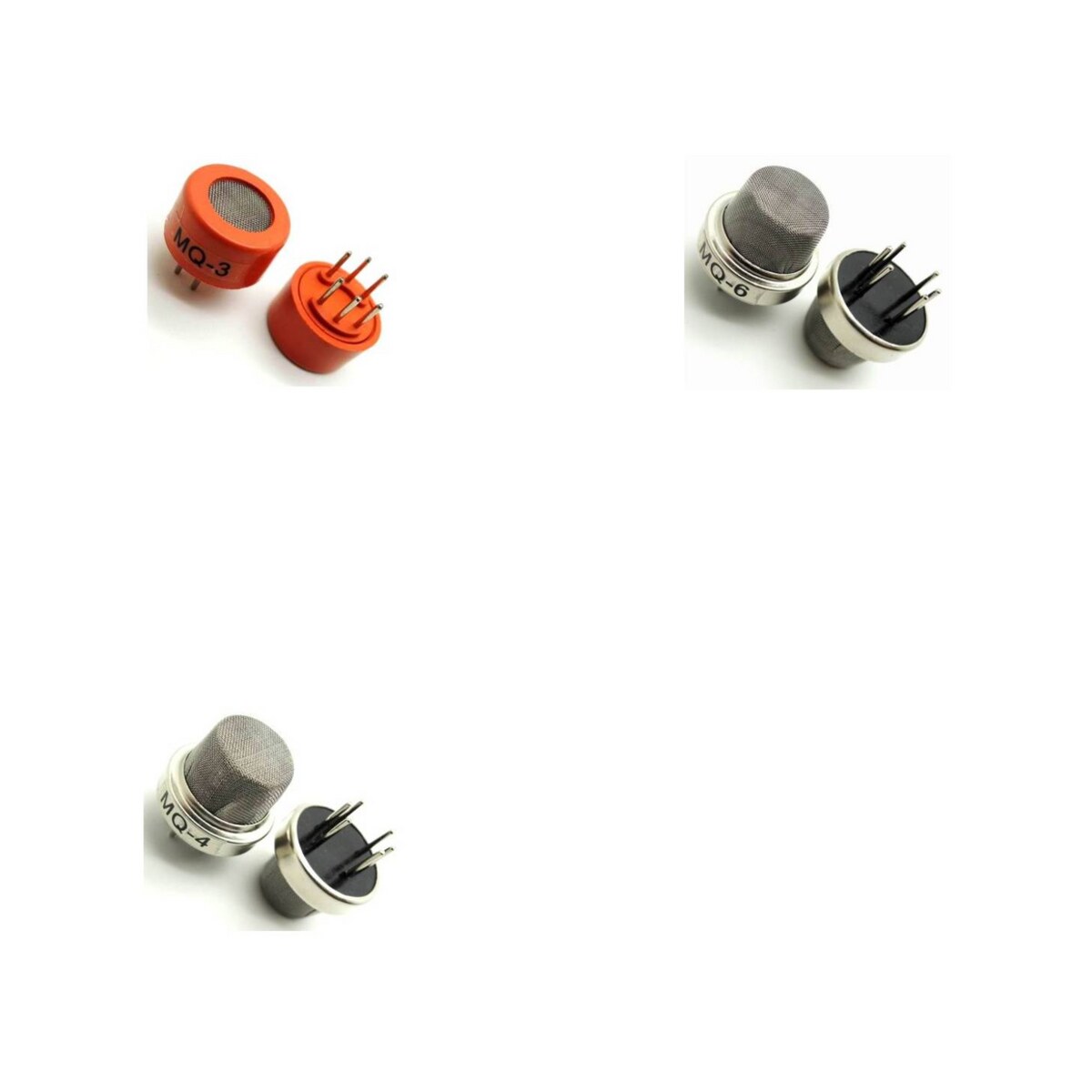
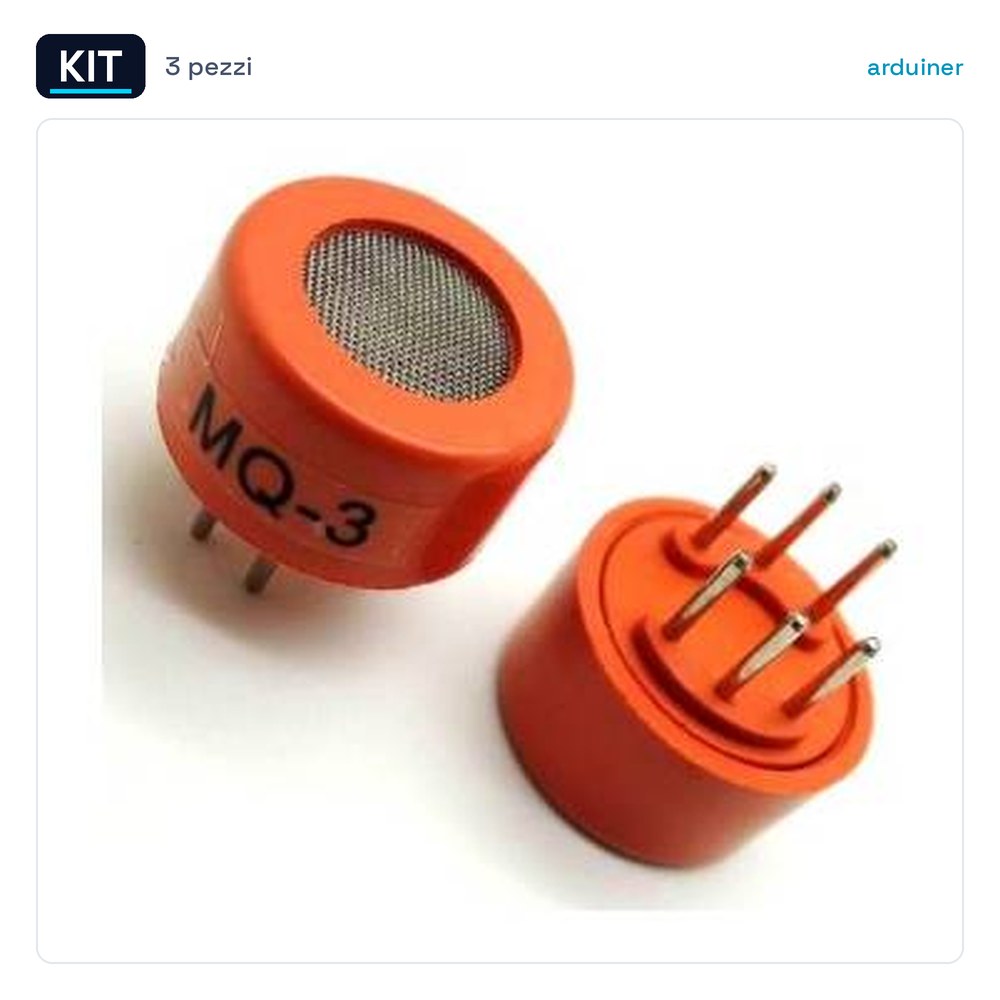
The MQ-3 Alcohol Gas Detector Kit, MQ-6 Iso Gas Detector, and MQ-4 Gas Sensor for Arduino is a set of gas sensors designed for detecting various types of gases and vapors for environmental monitoring and safety applications. These sensors are compatible with the Arduino platform and can be used to monitor alcohol, isobutane, butane, propane, LPG, smoke, methane, and other flammable gases.
Each sensor in the kit is provided with an integrated circuit that provides an analog signal proportional to the concentration of the detected gas. These signals can be read and analyzed by an Arduino microcontroller to determine the presence and concentration of gases.
Sensors are designed to be easily integrated into monitoring and alarm systems, suitable for both domestic and industrial applications.
Key Specifications
| Parameter | Value |
| Model | MQ-3 |
| Model | MQ-6 |
| Model | MQ-4 |
| Quantity | 3 pieces |
| Supply Voltage | N/D (see manufacturer’s datasheet) |
| Interface | Analog |
| Dimensions | N/D (see manufacturer’s datasheet) |
| Container | N/D (see manufacturer’s technical sheet) |
Installation and Usage
- Check the sensor’s compatibility with the Arduino microcontroller.
- Connect the sensor to the Arduino microcontroller using the provided connectors.
- Power the sensor with the correct voltage as specified in the manufacturer’s documentation.
- Configure the microcontroller to read analog signals from the sensor.
- Perform an initial test to verify that the sensor correctly detects gases.
Compatibility and Requirements
- The kit is compatible with Arduino and other compatible microcontrollers.
- Requires an Arduino microcontroller or compatible to read analog signals.
- Can be integrated into monitoring and alarm systems.
- Requires software for reading and analyzing analog signals.
Limitations and Important Notes
- Cannot detect all types of gases.
- Requires proper electrical power.
- Be aware of the presence of flammable gases during installation.
- The sensitivity of the sensor may vary over time and use.
Troubleshooting
The sensor does not detect gases correctly.
Probable cause: Incorrect electrical power or interrupted connections.
Solution: Check and repair electrical connections and verify power supply.
The analog signal is unstable.
Probable cause: Non-optimal environmental conditions or electrical interference.
Solution: Improve environmental conditions and reduce electrical interference.
The sensor does not respond after the first installation.
Probable cause: Possible damage to the sensor during transportation.
Solution: Check the sensor for any damage and replace it if necessary.
The sensor detects gases that are not present.
Probable cause: Sensor sensitivity not calibrated correctly.
Solution: Calibrate the sensor following the manufacturer’s guide.
Use cases
Home Security System
Objective: Monitor the presence of flammable gases in the home.
What’s needed: MQ-3, MQ-6, and MQ-4 kit.
Steps: 1) Install the kit in key points of the house. 2) Configure the alarm system. 3) Test the system with test gas.
Expected result: The home security system monitors and alerts in case of flammable gas presence.
Industrial Monitoring Project
Objective: Monitor gas concentration in an industrial environment.
What’s needed: MQ-3, MQ-6, and MQ-4 kit.
Steps: 1) Install the sensors in key points of the industrial environment. 2) Connect the sensors to a monitoring system. 3) Configure the monitoring system to detect gas concentrations.
Expected result: The industrial monitoring system detects and records gas concentrations.
Parking Safety System
Objective: Prevent incidents caused by explosive fuels.
What is needed: MQ-3, MQ-6, and MQ-4 kit.
Steps: 1) Install the sensors at key points in the parking area. 2) Connect the sensors to an alarm system. 3) Test the system with test gases.
Expected result: The safety system prevents incidents caused by explosive fuels.
Environmental Monitoring Project
Objective: Monitor the presence of harmful gases in an environment.
What is needed: MQ-3, MQ-6, and MQ-4 kit.
Steps: 1) Install the sensors at key points in the environment. 2) Connect the sensors to a monitoring system. 3) Configure the monitoring system to detect gas concentrations.
Expected result: The environmental monitoring system detects and records harmful gas concentrations.
Laboratory Monitoring Project
Objective: Monitor dangerous gas presence in a laboratory.
What’s needed: MQ-3, MQ-6, and MQ-4 kits.
Steps: 1) Install sensors in key points of the laboratory. 2) Connect sensors to a monitoring system. 3) Configure the monitoring system to detect gas concentrations.
Expected result: The laboratory monitoring system detects and records dangerous gas concentrations.
Warehouse Monitoring Project
Objective: Prevent incidents caused by flammable gases in a warehouse.
What’s needed: MQ-3, MQ-6, and MQ-4 kits.
Steps: 1) Install sensors in key points of the warehouse. 2) Connect sensors to an alarm system. 3) Test the system with test gases.
Expected result: The safety system prevents incidents caused by flammable gases.
Garage Monitoring Project
Objective: Prevent incidents caused by flammable gases in a garage.
What’s needed: MQ-3, MQ-6, and MQ-4 kits.
Steps: 1) Install sensors in key locations in the garage. 2) Connect the sensors to an alarm system. 3) Test the system with test gas.
Expected outcome: The safety system prevents incidents caused by flammable gases.
Heating system monitoring project
Objective: Monitor the presence of dangerous gases in a heating system.
What’s needed: MQ-3, MQ-6, and MQ-4 kits.
Steps: 1) Install sensors in key locations in the heating system. 2) Connect the sensors to a monitoring system. 3) Configure the monitoring system to detect gas concentrations.
Expected outcome: The heating system monitoring system detects and records dangerous gas concentrations.
In the package
- 3 pieces
Complete the project
- MQ135 Air Quality Sensor Module Harmful Gas Detection ammonia (NH3), nitrogen oxides (NOx), alcohol, benzene vapors, smoke, carbon dioxide (CO2): For a more comprehensive air quality monitoring.
Technical FAQs
What types of gases can the MQ-3, MQ-6, and MQ-4 kits detect?
The kit can detect alcohol, isobutane, propane, butane, LPG, smoke, methane, and other flammable gases.
How can I calibrate the sensor to accurately detect gases?
Sensor calibration should be performed following the manufacturer’s guide.
What are the power requirements for the kit?
Power requirements are specified in the manufacturer’s documentation.
How can I integrate the kit into a monitoring system?
The kit can be integrated into a monitoring system using an Arduino microcontroller or compatible device.
Reviews
There are no reviews yet.