 EN
 IT Italiano
 ES Español
 FR Français
 DE Deutsch
Description
Technical Specifications
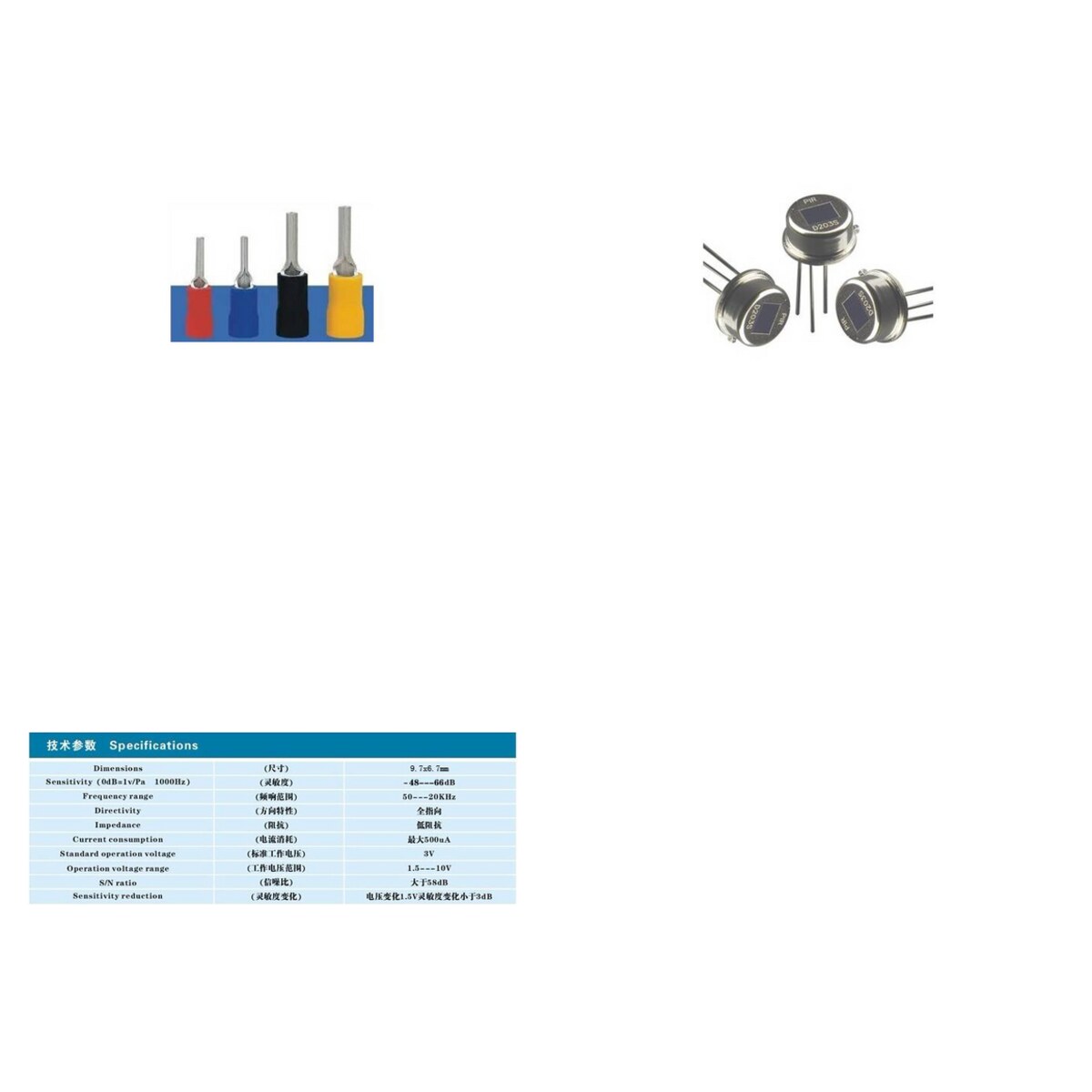
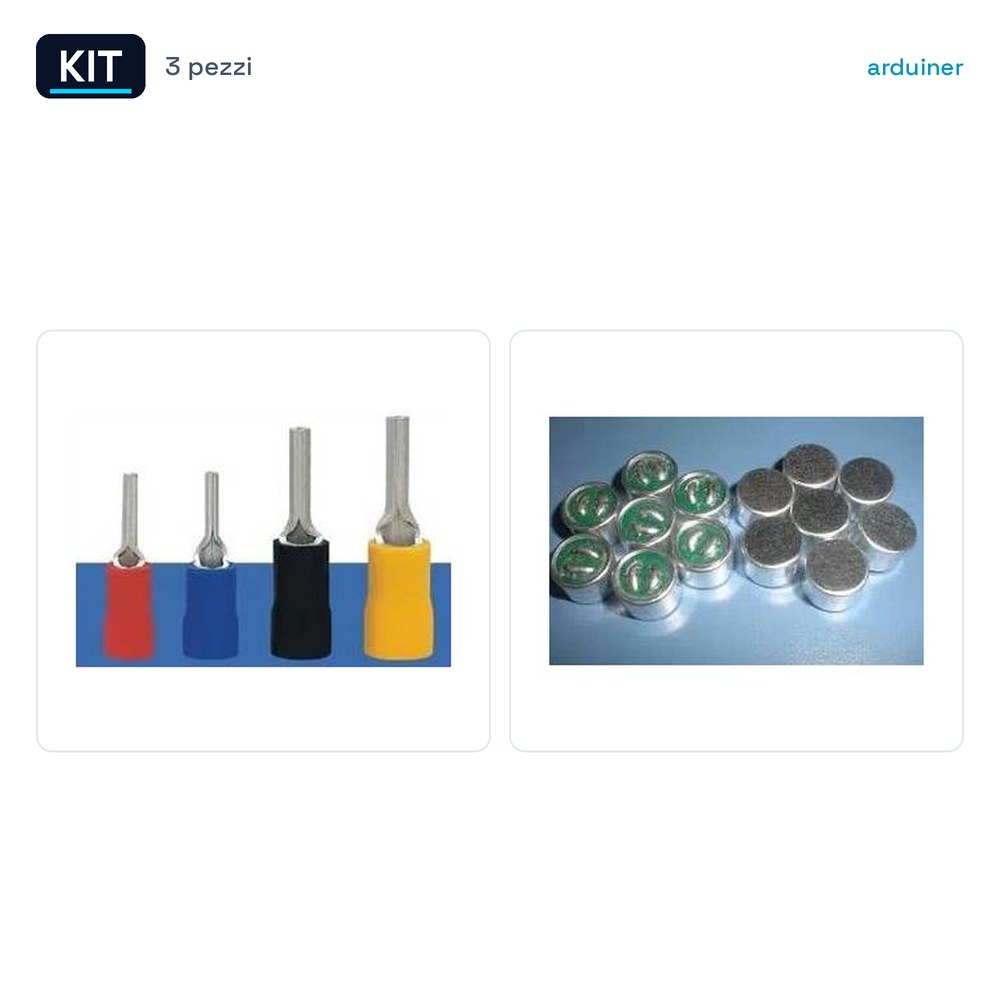
The product is a kit containing 100 PTV1-10 wire terminals in copper, an RE200B infrared PIR sensor, and 5 high-sensitivity microphones. The PTV1-10 wire terminals are used to facilitate electrical connections between wires and circuits, while the RE200B infrared PIR sensor is designed to detect movements based on the heat emitted by objects or people. The high-sensitivity microphones are suitable for audio applications that require a good signal-to-noise ratio.
The PTV1-10 wire terminals are pre-insulated and feature a copper end for easy crimping of wires. The RE200B infrared PIR sensor is a radial device that uses pyroelectric technology to detect movements in a specific area. The microphones have a diameter of 10mm and a length of 6.5mm, providing high acoustic sensitivity.
This kit is suitable for electronic projects that require sturdy connectors, motion sensors, and sensitive audio devices.
Key Specifications
| Parameter | Value |
| Connector Model | PTV1-10 |
| Quantity of Connectors | 100 |
| PIR Sensor Model | RE200B |
| Quantity of PIR Sensors | 1 |
| Microphone Model | High Sensitivity |
| Quantity of Microphones | 5 |
| Microphone Diameter | 10mm |
| Microphone Length | 6.5mm |
| Connector Type | N/A (see manufacturer’s technical sheet) |
| Container | N/A (see manufacturer’s technical sheet) |
Installation and Usage
- Connect the PTV1-10 leads to the wires using the copper ends.
- Ensure the PIR RE200B detector is correctly positioned in the monitoring area.
- Connect the high-sensitivity microphones to the power and data cables.
- Power the PIR RE200B detector with the correct voltage.
- Connect the microphones and PTV1-10 leads to the electronic circuit to complete the setup.
Compatibility and Requirements
- The kit is compatible with various Arduino boards and electronic prototyping systems.
- An appropriate power supply is required for the PIR RE200B detector and microphones.
- A support circuit is needed to connect the PTV1-10 leads.
Limitations and Important Notes
- The kit does not include a specific power supply.
- PTV1-10 leads are not suitable for long-distance connections.
- The PIR RE200B detector requires a stable position to function correctly.
- High-sensitivity microphones can capture ambient noises.
Troubleshooting
The PIR detector does not detect movements.
Probable cause: The power supply voltage is incorrect.
Solution: Check and adjust the power supply voltage.
Microphones record unwanted noises.
Probable cause: Suboptimal position.
Solution: Reorganize the position of the microphones.
PTV1-10 leads do not connect well.
Probable cause: Cable not crimped correctly.
Solution: Repack the cable.
The PIR detector detects incorrect movements.
Probable cause: Too noisy environment.
Solution: Reorganize the position of the detector.
Use cases
Parking sensor for the garage
Objective: Detect movements inside the garage.
Required: PIR Sensor RE200B
Steps: 1) Install the sensor in a central location 2) Power the sensor 3) Test motion detection
Expected Result: The sensor correctly detects movements inside the garage.
Home Security System
Objective: Monitor movements inside the house.
Required: PIR Sensor RE200B and microphones
Steps: 1) Install the sensor in a room 2) Connect the microphones 3) Test the security system
Expected Result: The system detects movements and records sounds.
Electronic Prototyping Project
Objective: Test connectors and sensors.
Required: PTV1-10 connectors and PIR sensor
Steps: 1) Connect the connectors to the cables 2) Power the sensor 3) Test motion detection
Expected Result: The sensor works correctly with the connectors.
Home Automation Project
Objective: Control lighting based on movements.
What’s needed: PIR RE200B detector and microphones
Steps: 1) Install the detector and microphones 2) Connect to the lighting 3) Test automatic lighting
Expected result: The lighting turns on and off automatically.
Environmental Monitoring Project
Objective: Monitor ambient noise.
What’s needed: Microphones
Steps: 1) Install the microphones in various positions 2) Connect to the data cables 3) Test sound recording
Expected result: Ambient sounds are recorded correctly.
Audio Prototyping Project
Objective: Test microphone sensitivity.
What’s needed: Microphones
Steps: 1) Install the microphones 2) Connect to the data cables 3) Test sound recording
Expected result: The microphones record sounds with high sensitivity.
Movement Prototyping Project
Objective: Test motion detection.
Required: PIR sensor
Steps: 1) Install the sensor 2) Power the sensor 3) Test motion detection
Expected result: The sensor correctly detects motion.
Prototype connector project
Objective: Test the stability of the PTV1-10 connectors.
Required: PTV1-10 connectors
Steps: 1) Connect the connectors to the cables 2) Test the stability of the connections
Expected result: The connectors maintain stable connections.
In the package
- 100 Pieces PTV1-10 Terminal Connectors, the copper ear copper nose, Terminals, pin Preisolated Terminals, 1 PIR Sensor RE200B Infrared Pyroelectric Radial, 5 Pieces High Sensitivity Microphone Diameter 10mm*6.5mm
Complete the project
- 100 Pieces RV2-4 Spade Terminal Connectors, round Terminals, Preisolated terminal lug, copper wiring nose: Used to connect the cables to the PTV1-10 connectors
- 100 Pieces PTV2-10 Wire Terminals, the copper ear copper nose, Terminals, pin Preisolated Terminals: Used to connect cables to microphones
- 5V / 1A three-terminal ultra-small voltage regulator block / LM7805 substitute Input 5.5 ~ 32 V high efficiency: Used to power the PIR RE200B detector
- 10 Pieces Spring Terminal 2.8MM Terminals, cold terminal, copper With silicone housing
- 2 Pieces Spring Terminal Connectors XY118 5.0mm 2 Pins
Technical FAQs
The PIR sensor does not detect movements?
Check the power supply voltage and the position of the sensor.
Do the microphones record unwanted noises?
Reorganize the position of the microphones to reduce ambient noise.
The PTV1-10 wire terminals do not connect well?
Repack the cable to improve the connection.
The PIR sensor detects incorrect movements?
Reorganize the position of the sensor to reduce ambient noise.

Reviews
There are no reviews yet.